Sep 14, 2026CNC Machining
CNC Machining Tolerance Stack-Up: Solving Assembly Problems
Learn how CNC machining tolerance stack-up causes assembly problems and how DFM review, GD&T, and tolerance analysis improve precision manufacturing results.
CNC Machining Tolerance Stack-Up: Solving Assembly Problems
You receive a batch of precision machined components. The incoming quality control team measures them against the 2D drawings, and every single part passes inspection. However, when the production team attempts to bolt the mating flanges together, the dowel holes do not align, and the components simply do not fit.
This scenario causes severe CNC assembly problems, leading to production line delays, finger-pointing between design and manufacturing teams, and costly rework. The root cause of this frustration is rarely a machining error on the shop floor; it is almost always an unchecked CNC machining tolerance stack-up.
What is CNC Machining Tolerance Stack-Up?
In precision manufacturing, no machine can produce a dimension with absolute zero variation. To account for this, engineers assign acceptable limits, or tolerances, to every feature. Tolerance stack-up (or accumulation) occurs when the dimensional variations of multiple mating features add up across an assembly.
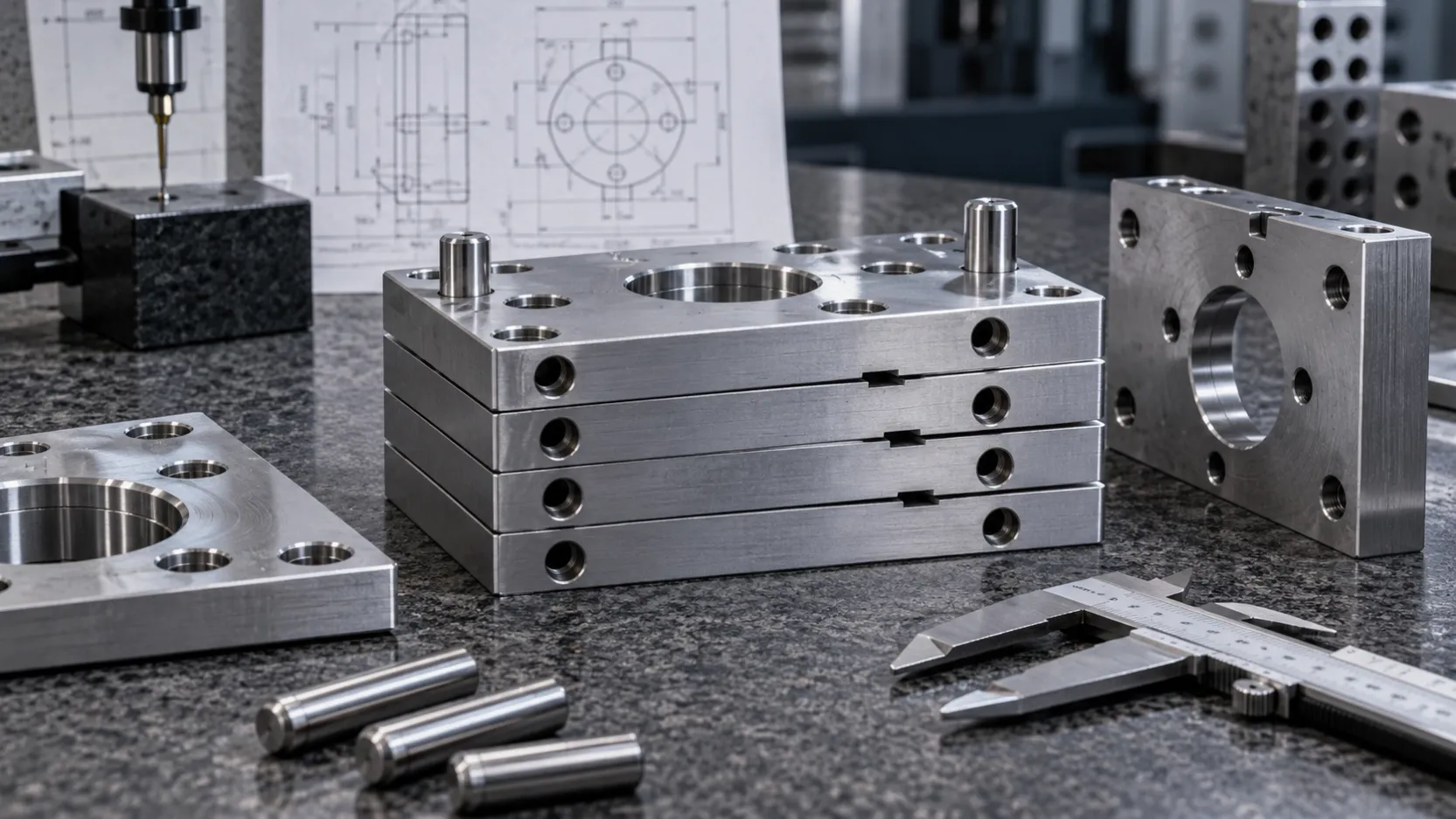
If three mating plates are each machined to their extreme allowable limits, the individual deviations combine. While Plate A, Plate B, and Plate C might each be technically "in spec," their combined variation can easily exceed the available physical clearance. When the accumulated variation surpasses the designed envelope, mechanical interference occurs, preventing assembly.
Why Precision CNC Machining Can't Fix Drafting Flaws
A common misconception is that utilizing higher-end machinery will automatically resolve assembly interference. While precision CNC machining provides exceptional repeatability, a machine shop strictly builds to the print provided.
If a 2D drawing uses chain dimensioning—where dimensions are placed end-to-end—the tolerances inherently accumulate sequentially. The starting point for one feature becomes the endpoint of the previous one, meaning the location of the final feature absorbs the variations of all preceding features. A machinist cannot fix an interference issue if the cumulative tolerances on the provided drawing mathematically allow for a collision. Resolving this requires proactive engineering before the first chip is cut.
DFM Solutions to Prevent Tolerance Accumulation
Eliminating assembly risks requires identifying and controlling how components interact in the real world. A structured DFM review (Design for Manufacturability) is the most effective way to align your drawings with your functional requirements.
- Conduct a Tolerance Stack-Up Analysis: Before finalizing prints, calculate the worst-case scenario where all components are at their Maximum Material Condition (MMC). If a worst-case tolerance stack-up analysis reveals potential interference, the design or clearance must be adjusted.
- Implement Baseline Dimensioning: Replace chain dimensioning with baseline dimensioning. By referencing all critical features from a single, shared functional datum, each feature's variation remains independent, preventing sequential accumulation.
- Apply GD&T Tolerance Control: Standard linear tolerances (+/-) only control size, not orientation or location. Utilizing GD&T tolerance control (Geometric Dimensioning and Tolerancing)—specifically Position and Profile callouts—establishes clear, geometric boundary zones that directly govern how mating features align.
- Establish Functional Datums: Ensure the datums on your drawing match the physical mating surfaces used in the final assembly, rather than arbitrary edges that are simply easy to measure.
(Internal Link Note: To understand more about how datums and geometry affect the production floor, read our guide on [CNC Machining Assembly Problems: Why Parts Fail to Fit].)
Frequently Asked Questions
1. What is the difference between worst-case and statistical tolerance stack-up analysis? Worst-case analysis assumes all dimensions hit their extreme allowable limits simultaneously, ensuring reliable assembly but often demanding tight tolerances. Statistical analysis assumes variations follow a normal distribution, allowing for slightly looser individual tolerances while maintaining a low, calculated risk of assembly failure.
2. How does chain dimensioning cause CNC assembly problems? Chain dimensioning links tolerances end-to-end. The position of the final feature is affected by the variations of every preceding feature, causing the total tolerance to accumulate linearly and quickly exceed assembly clearances.
3. Why is GD&T better for managing stack-up than linear tolerances? Linear tolerances create ambiguous rectangular tolerance zones that do not adequately control shape or orientation. GD&T tolerance control shifts the focus to geometric zones (like cylindrical tolerance zones for holes), providing precise control over the location and orientation of mating features.
4. Can a machine shop detect tolerance stack-up before machining? A proactive manufacturing partner will identify risky dimensioning practices during an initial DFM review. However, if a shop simply "builds to print" without questioning the assembly intent, the stack-up will only be discovered on the assembly line.
Partner with Golden Rainbow for Precision Manufacturing
Tolerance stack-up is an inevitable factor in mechanical design, but it does not have to dictate your production timeline. Strategic tolerance allocation and proper engineering oversight empower you to manufacture components that assemble predictably and function reliably.
Golden Rainbow operates as a true precision CNC machining partner, offering comprehensive support beyond the spindle. Our engineering team provides thorough DFM reviews, detailed tolerance analysis, and deep GD&T understanding to identify functional risks before manufacturing begins. If you are developing a multi-part assembly and want to eliminate interference issues, share your CAD models with our team to secure reliable, cost-effective precision manufacturing support.