Process1
5-Axis CNC Machining
5-Axis CNC Machining for Complex Parts, Done in One Setup
Golden Rainbow provides 5-axis CNC milling in Shenzhen, China, for complex parts that would need several setups on a 3-axis machine.
Drawings can also be emailed to stellachen@goldenrainbow.com.
Standard tolerance
±0.05 mm
Minimum order
1 piece
Quote response
Within one working day
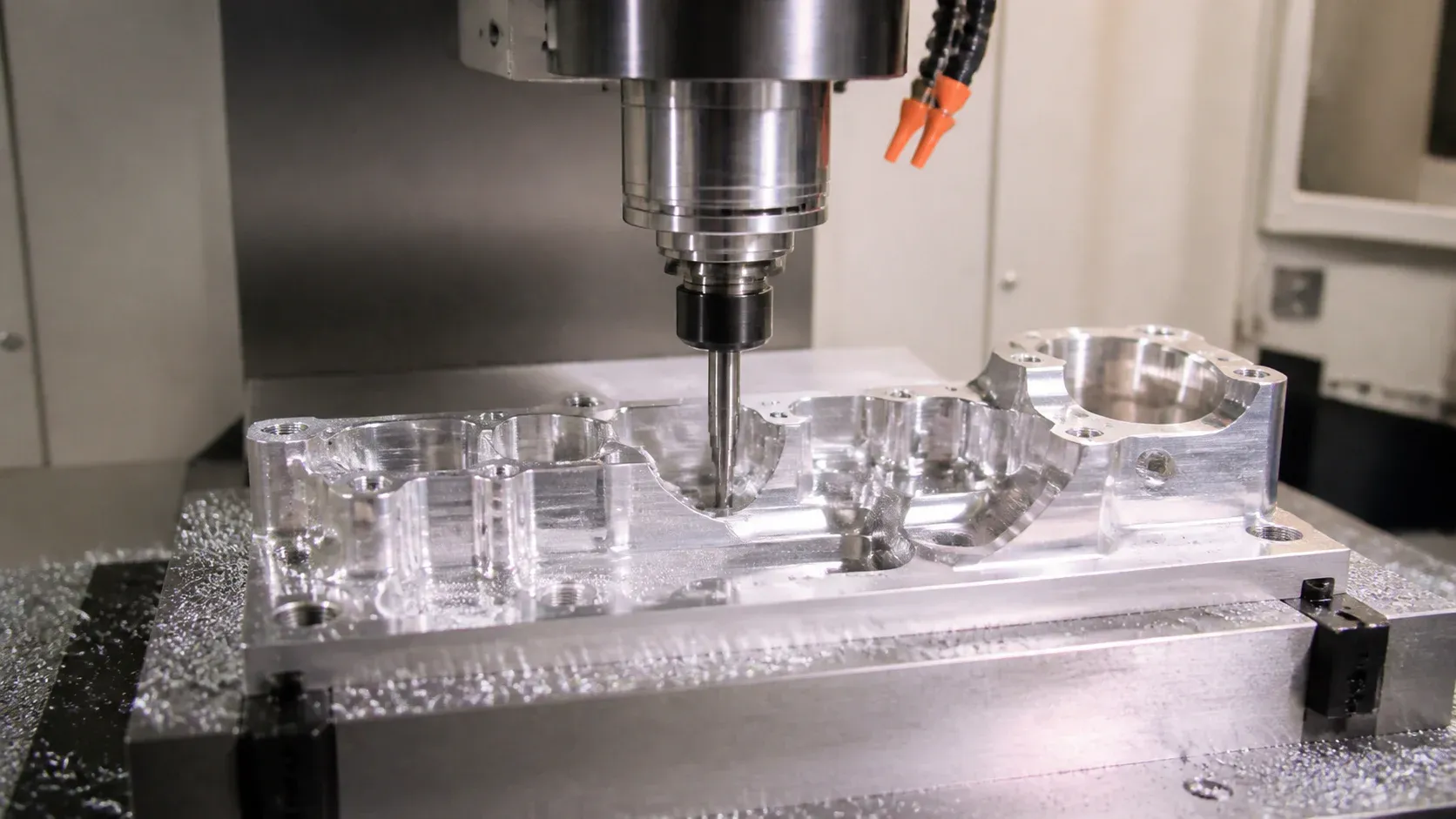
Parts are milled in aluminium, stainless steel, brass, copper, tool steel and titanium, to a standard tolerance of ±0.05 mm, from 1 piece, with engineer-reviewed quotes within one working day.
If your part has faces on several sides, a curved surface a straight tool cannot reach cleanly, or angled holes that would otherwise need a new fixture for every angle, this page explains when 5-axis milling is the right route, what one setup changes in practice,
and what to send us for an engineer-reviewed quote.
When a Part Needs 5-Axis
Not every part needs five axes, and using 5-axis milling where a simpler route would do only adds cost. The clearest sign is how often the part would have to be unclamped and repositioned on a 3-axis machine:
Every repositioning is a new chance for a small location error, and those errors add up across faces that later have to fit, seal or line up with mating parts.
Four features point most reliably to 5-axis work:
Features on multiple faces
Dimensioned from common datums.
Freeform or curved surfaces
The tool must stay at a controlled angle.
Angled holes and inclined features
Machined at their true angle in the same setup.
Deep cavities with tight corners
Tilting the tool shortens its effective reach and reduces vibration.
A practical self-check: if the part needs three or more orientations on a 3-axis machine, if two faces that must align would be machined in different setups, or if the tightest tolerances sit between features on different faces, ask for a 5-axis review.
If the part is essentially flat and finished from one or two sides, tell us that too — the review may point to 3-axis or 4-axis milling as the cheaper route, and we would rather say so before quoting than build an unnecessary process into your price.
What One Setup Changes
Machining in one setup means the part is clamped once and the machine reaches the required faces by moving tool and part together, instead of stopping to refixture and re-establish datums by hand.
The main benefit is the tolerance chain: when related features are cut in a single clamping, their relative positions come from one datum scheme, so the error that usually accumulates between setups is largely removed from the features that matter most to fit and function.
One setup also makes delivery more predictable: fewer refixturing steps mean fewer queues between operations, and a simpler route to repeat when an approved sample — made by substantially the same process — comes back as a production order.
The limits are worth stating plainly. One setup does not remove the need for clear datums or realistic tolerances, and it does not make every tolerance automatically achievable.
Critical features still need individual review, and some parts will still need a second operation for a face no single clamping can expose. We raise those points during drawing review, before quotation.
Capabilities
Standard tolerance2
±0.05 mm
Critical features3
±0.01 mm
Subject to drawing review and confirmation
Minimum order quantity4
1 piece
Samples5
3–7 working days
Production6
10–15 working days, depending on quantity and complexity
Maximum part size7
Up to 600 × 500 × 400 mm
(typical work envelope; final capability confirmed against your drawing)
Materials8
Aluminium, stainless steel, brass, copper, tool steel, titanium
Files for quotation9
STEP file + dimensioned PDF
With material, quantity and key tolerances noted
Quote response10
Engineer drawing review and reply within one working day
Read the tolerance lines together. The tighter figure is not a blanket promise for a whole part: it applies to individual critical features, only where geometry, material and inspection access allow it.
— which is why every drawing with a critical callout is reviewed by an engineer before it is confirmed in a quotation.
If a tolerance cannot be held reliably, we will say so at review stage.
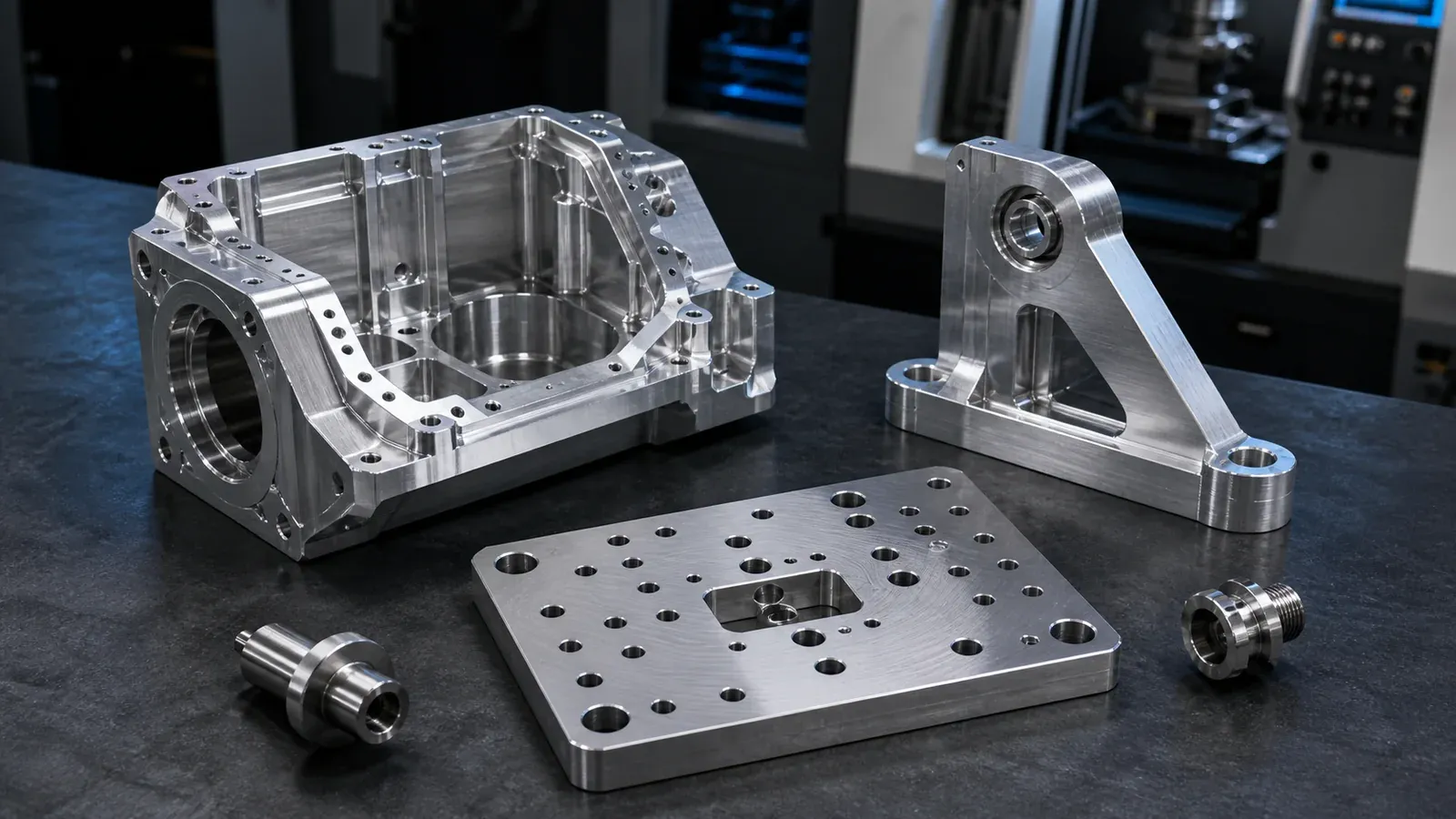
Typical 5-Axis Parts
The parts that benefit most share a shape problem rather than a single industry. Multi-face housings are a common example: a shell or enclosure where the internal cavity, mounting faces and hole pattern must stay in position relative to one another —
One setup keeps those relationships in a single datum scheme instead of reconstructing them at every flip.
Brackets with angled faces
Are a second group: easy to describe on a drawing, awkward to fixture repeatedly, while on a 5-axis machine the angle between the planes is cut in one clamping.
Impeller-type and other strongly curved shapes
Form a third group, where the tool must follow a continuously changing surface.
Parts of this kind are shown on this page only as finished machined parts: a photograph alone cannot establish what a part is for.
The same logic applies to blocks with intersecting angled passages, sculpted tooling components, and complex prototypes whose design is still moving.
Simpler part? Parts needing both milling and turning are covered on our CNC Milling and Turning page.
Finished machined parts
Materials
This page covers the six metals confirmed for Golden Rainbow's machining work: aluminium, stainless steel, brass, copper, tool steel and titanium.
No other material is claimed here, and no specific grade is named, because the grade on your drawing is what an engineer reviews before confirming material, process and price.
If a grade you need is not one we machine, we will tell you at review stage rather than substituting a different material without your agreement.
In general terms, aluminium suits housings, brackets and curved parts where weight matters.
Stainless steel
Is chosen where corrosion resistance or strength drives the design, accepting that it machines more slowly.
Brass and copper
Appear most often in fittings where conductivity or sealing matters.
Tool steel
Serves wear-resistant tooling components.
Titanium
Is specified where the strength-to-weight ratio justifies a more demanding route, and complex titanium parts are among the clearest cases for a 5-axis review, because tool access decides whether the part can be finished in one setup.
Send the grade exactly as it appears on your drawing: grade, tolerance and quantity together decide the quotation.
Quality and Inspection
Quality on a complex part starts before metal is cut. Every enquiry drawing goes through an engineer review that checks datums, critical tolerances, tool access and inspection access, and any ambiguous feature is raised at quotation stage, not discovered after machining.
Agreeing each critical feature's dimension, datum and tolerance up front prevents a part that measures well face by face but does not assemble.
During machining, key dimensions are checked as the process proceeds, so drift is caught on the first parts rather than at the end of a batch.
Finished parts receive a final inspection against the drawing before packing and dispatch, and any feature confirmed as critical during review is treated as a critical check.
If inspection shows a problem, the part is held and the cause addressed before anything ships. If your project needs anything specific documented with the delivery, tell us at enquiry stage so it can be agreed in the quotation.
Frequently Asked Questions
Q11
When is 5-axis worth it over 3-axis?
When a part would need three or more setups on a 3-axis machine, or carries curved surfaces, inclined faces or angled holes whose positions matter to each other — one setup then protects the relationships between features better than repeated refixturing.
For a flat part finished from one or two sides, 3-axis milling is normally sufficient and cheaper.
Q22
What tolerance can 5-axis machining hold?
Our standard tolerance is ±0.05 mm. Individual critical features can reach ±0.01 mm, subject to drawing review and confirmation, because achievability depends on geometry, material and access for machining and inspection.
Send the drawing with critical features clearly called out, and the quotation will confirm which tolerances are accepted as written.
Q33
Can you start from 1 piece?
Yes. The minimum order quantity is 1 piece. Samples normally take 3–7 working days depending on complexity, and production takes 10–15 working days depending on quantity and complexity, using the same one-setup process as the approved sample.
Q44
What files do you need for a quote?
Send a STEP file with a dimensioned PDF drawing, noting the material and grade exactly as specified, the quantity, the tolerances, and any datum or assembly requirement the model alone does not show.
The RFQ form has no file-upload field, so email drawings to stellachen@goldenrainbow.com, or start through /request-a-quote and email the files straight after.
Q55
How fast is the quote?
An engineer reviews the drawing and replies within one working day. A complete file set can often be priced in that first reply; a complex part may come back with questions about a critical tolerance, a datum, tool access or a grade.
Resolving them at quotation stage is deliberate — it is far cheaper than remaking a finished part.
Get a Quote
Send your STEP file and dimensioned PDF to stellachen@goldenrainbow.com, or submit the enquiry through /request-a-quote and email the files straight after.
Include the material and grade, the quantity — even if it is a single piece — and the tolerances that matter most.
An engineer will review the drawing and reply within one working day, with a quotation or with the questions that must be answered before a reliable price can be given.
Still deciding whether the part needs five axes at all? Send it anyway and say so: the review will state which route we recommend — 5-axis, 4-axis or 3-axis milling, or a milled-and-turned route — and why.